strynkdossier YouTubeInstagramFacebook Subscribe

Strynk Dossier · Declassifying wealth behavior

Why doing everything right with money can still feel like falling behind.

Case files on the psychology of money. Each one follows a money moment that doesn't add up, then opens the evidence: the experiments, the data and the mechanism behind the feeling.

LATEST · FILE 011You Set a Christmas Budget. Why Do You Always Go Over?28 Nov 2026 · Open file →
Case files11All out
Shorts33All out
Sources cited82studies and datasets

Case files

Newest first. Tap a file to open it below.

  1. Watch ↗
  2. Watch ↗
  3. Watch ↗
  4. Watch ↗
  5. Watch ↗
  6. Watch ↗
  7. Watch ↗
  8. Watch ↗
  9. Watch ↗
  10. Watch ↗
  11. Watch ↗
File 011 · 28 Nov 2026

You Set a Christmas Budget. Why Do You Always Go Over?

Case closed

It's almost midnight, two days before Christmas. On the fridge is the gift list you both agreed on, with a thousand circled in red at the top. The card app says almost seventeen hundred. Over one December, a 35-year-old and his partner Maya watch small "just this once" lines get added to that list in pen. Then he counts them. We test it against research on how people predict their spending and what a pricier gift buys, and against the case that spending less costs you too.

The pattern: across ten studies that used bank and budgeting-app data, people predicted next month's spending about a sixth too low on average, and the biggest reason was that unusual expenses don't come to mind. In a small one-week study of students, everyday spending was guessed almost to the dollar, while one-off spending (gifts are on that list) was missed by a wide margin. Our read: December doesn't break your budget in one go. It breaks it into exceptions, each too small to stop. And the extra you add to each one buys a thank-you that grows far less than the price.

Our readDecember doesn't break your budget in one go.

File 010 · 24 Nov 2026

If You Can Afford Every Payment, Why Are You Always Broke?

Case closed

"What monthly payment are you comfortable with?" You say "around five hundred" before anyone has told you a price. Over one Saturday at a car dealership, a 35-year-old counts the six monthly payments he already has, each one fine on its own, then turns the salesman's worksheet over and does the one sum nobody asked for. We test it against research on how borrowers choose payments, and the strongest case that for many households the monthly payment really is the limit.

The pattern: in about half a million US credit-union used-car loans, when lenders offered people better terms (a lower rate or a longer loan), most didn't keep the lower payment. They borrowed more, until the payment matched what they'd have paid without the offer. In Q3 2026, of new-car buyers paying $1,000 a month or more, about seven in ten had stretched the loan to six years or longer. Our read: a monthly payment is a price with the length hidden. "Does it fit?" can almost always find a yes, because the months can stretch. "What does it cost?" can't.

Our readA monthly payment is a price with the length hidden.

File 009 · 20 Nov 2026

POV: Your Friends Think You're Loaded. Your Bank App Says $1,140.

Case closed

You say "we're broke" before you've thought about it. The bank app says $1,140; on paper the two of you are worth about $275,000. Over one Saturday, from a backyard cookout to the couch at midnight, a careful saver finds out which of his numbers talk to him, and which one he stopped opening in March. We test that against the research: how people weigh what they owe against what they own, how often savers look at their retirement accounts, and the strongest case that some people really are short of cash.

The pattern: in one experiment, with net worth equal and positive, people judged the person who owed less as better off four times out of five. In 100,000 workplace retirement accounts, the typical saver logged in on 36 days in two years, and logins fell after a day the market dropped. Our read: feeling broke can be a loudness problem as much as a money problem. Debt sends a bill every month; wealth mostly waits for you to go and look. If your cash really runs out before payday, that's a real squeeze, not loudness: FILE 006 is about that.

Our readFeeling broke can be a loudness problem as much as a money problem.

File 008 · 16 Nov 2026

You Turned 35 and Fell Behind Overnight. Your Money Didn't Move.

Case closed

Same $90,000. One minute later, you're behind. On his 35th birthday, a careful saver types his net worth into a "how do you compare for your age" chart, and midnight moves him from ahead to behind without a dollar changing. We test that feeling against the research: how people picture savings growing, how a goal can turn a gain into a loss, and the strongest case that some people really are behind.

The pattern: most of us draw savings as a straight line, but savings that keep earning grow on a curve that starts flat. In one study, students' typical guess for 40 years of monthly saving was about a third of the real answer. Our read: an age chart is one dot, a snapshot of other people or a rule of thumb's guess about you, and a dot can't tell early from stuck. Your direction can. If you haven't started saving yet, the same curve is a warning, not a comfort.

Our readAn age chart is one dot, a snapshot of other people or a rule of thumb's guess about you, and a dot can't tell early from stuck.

File 007 · 9:01 · 12 Nov 2026

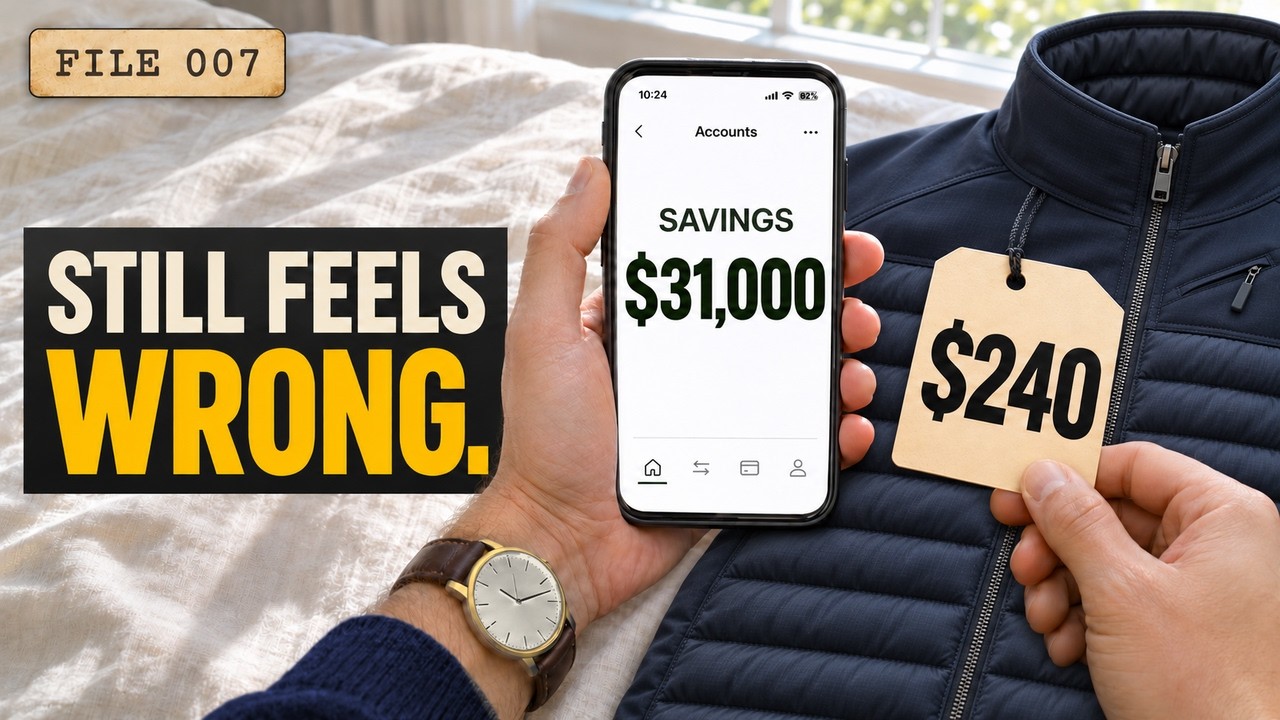
Why You Feel Guilty Spending Money (Even When You Can Afford It)

Case closed

You can afford the trip. You saved for exactly this. So why does booking it feel like losing? We follow one careful saver, a jacket with the tag still on and a cabin open in a tab for nine days, and test the feeling against the research: a survey of 13,000+ people on how spending feels, retirees who won't touch their savings, the strongest study against us, and what people regret looking back.

The pattern: the people who find spending hardest aren't the ones who are broke. In that survey the over-careful had more savings and far less card debt than the over-spenders, and the researcher behind it later wrote that neither group is happy with how they handle money. Our read: for a good saver, the balance becomes the scoreboard, so every purchase reads as points lost, and the feeling keeps saying no long after the math says yes. If you're still building your cushion, this file isn't telling you to spend. Building it is the job.

Our readFor a good saver, the balance becomes the scoreboard, so every purchase reads as points lost, and the feeling keeps saying no long after the math says yes.

File 006 · 10:59 · 8 Nov 2026

Why $100K Earners Live Paycheck to Paycheck (It's Not What It Sounds Like)

Case closed

Nearly half of people earning over $100,000 say they live paycheck to paycheck. So why have so many of them never missed a bill? We follow one paycheck, from Friday's deposit to Thursday's grocery line, and test the headline against what people actually ticked: a new Goldman Sachs survey, a bank's own account data, the Federal Reserve's money-left-over question, and the economists who named the "wealthy hand-to-mouth."

The pattern: the box people tick is about getting ahead, not running out, and in one survey about three in four six-figure earners who said it also said their bills got paid. Much of each paycheck is spoken for before payday, and much of what these households own is locked in a house or a 401(k). Our read: "paycheck to paycheck" covers three things: not getting ahead, money locked away or spoken for, and a real squeeze. Only the last is a shortage, and for some high earners, it is.

Our read"paycheck to paycheck" covers three things: not getting ahead, money locked away or spoken for, and a real squeeze.

File 005 · 11:08 · 5 Nov 2026

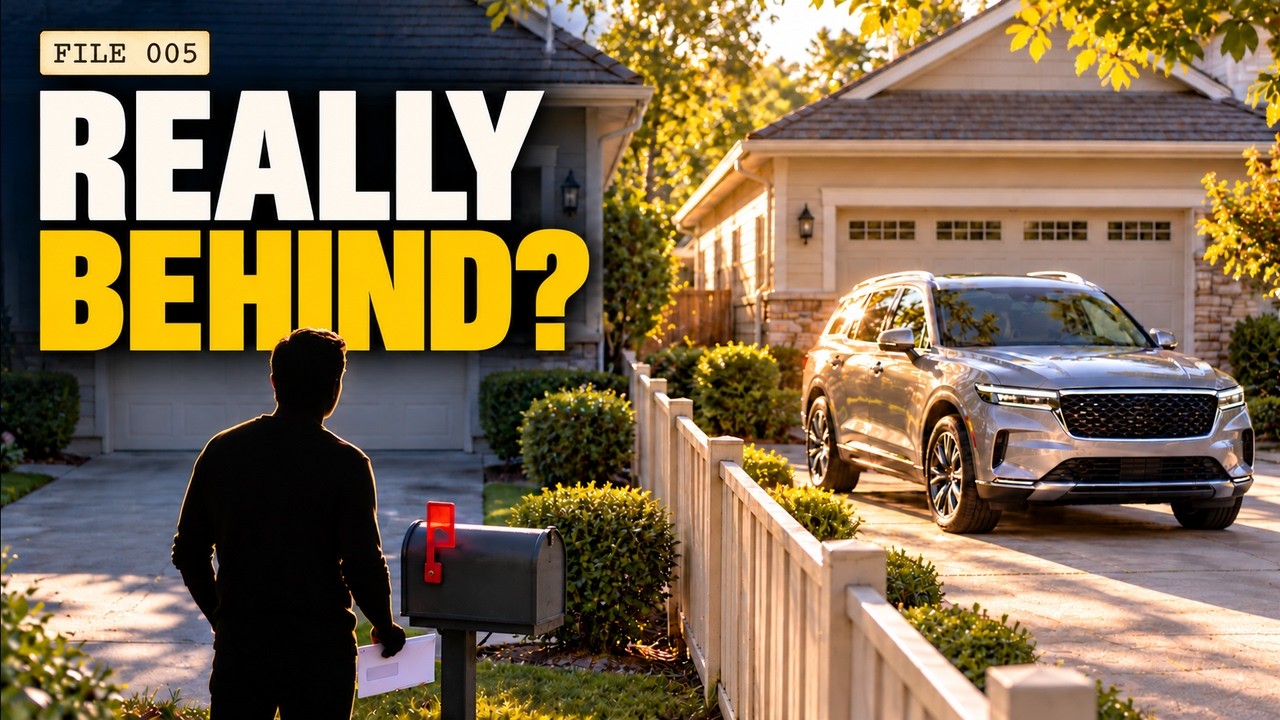
Why Everyone Seems Richer Than You (It's What You Can't See)

Case closed

Why does everyone on your street seem to be doing better than you? We follow one Saturday at the curb and test the feeling against the research: what people notice about each other's money, a Dutch lottery street, an experiment with over two thousand Dutch adults, the Federal Reserve's newest wealth survey, and a retirement letter that backfired.

The pattern: cars rank near the top of what people notice, life insurance near the bottom. Next door to a lottery winner, more neighbors bought a car. And when people learned their peers earned more than they'd guessed, their spending didn't grow; in that one study, it tilted toward what shows. Our read: you grade yourself on your whole ledger, and everyone else on the one line they can't hide. That's visibility bias, and it's why keeping up with the Joneses feels like falling behind.

Our readYou grade yourself on your whole ledger, and everyone else on the one line they can't hide.

File 004 · 15:04 · 1 Nov 2026

Why More Money Doesn't Feel Like More (Every Income Level)

Case closed

What does "comfortable" feel like at $34K, $58K, $95K, $150K and $2 million? We follow one life up five levels and test each against the research: Gallup, the Federal Reserve, studies from Germany, Switzerland, the Netherlands and Britain, and surveys of millionaires.

The pattern: the line you call "enough" climbs with you. People who earn 10% more call about 4% more "sufficient"; your own past income pulls on that line about twice as hard as other people's; and millionaires asked how much more wealth it would take to reach a perfect 10 most often said ten times. Our read: comfortable is a gap, not a number.

Our readComfortable is a gap, not a number.

File 003 · 11:01 · 27 Oct 2026

What Happens When You Win the Lottery? 20 Years of Data

Case closed

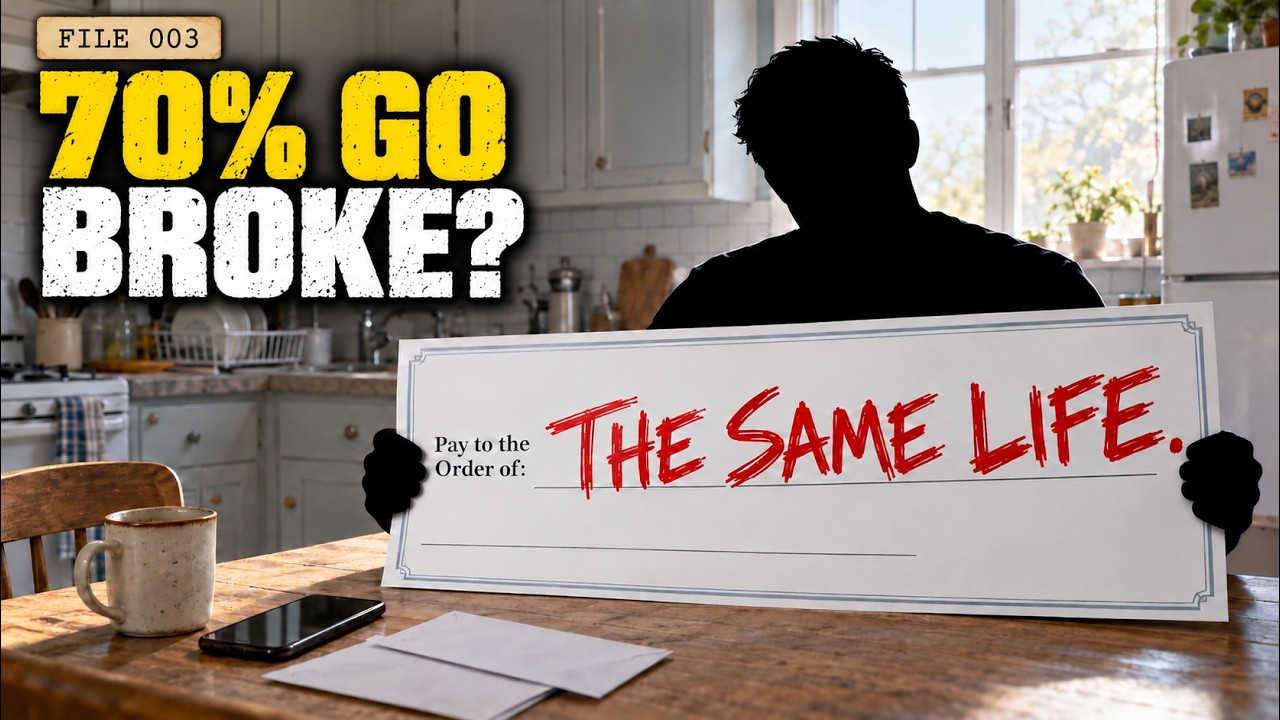
You've planned what you'd do if you won. You've also heard how that story ends: "70% of lottery winners go broke." We went looking for the study behind that number.

The 70% is usually credited to a nonprofit that says the figure isn't from its research and can't be confirmed. Real data does exist: tax records and bankruptcy filings on more than 100,000 winners, and surveys of winners up to 22 years after the win. In this file we follow one win year by year: who keeps working, how fast the money goes, why bigger Florida wins delayed bankruptcy instead of preventing it, what happens to the neighbors, and what still shows two decades on. Underneath it all is one line on the check: who it's made out to.

File 002 · 9:16 · 22 Oct 2026

Can Money Buy Happiness? The $75,000 Answer Was Wrong

Case closed

Can money buy happiness? For years the answer was a number: $75,000 a year. Then the researchers who disagreed re-ran the data together, and for most people that number turned out to be wrong.

In 2010, Daniel Kahneman and Angus Deaton found that day-to-day feelings leveled off near $75,000. In 2021, Matthew Killingsworth asked 33,391 working Americans "How do you feel right now?" 1.7 million times and found no ceiling. In 2023 the two sides re-ran his data together, with Barbara Mellers as referee. In this file we follow that evidence to the mechanism underneath: happiness rises in doublings, not dollars, and much of the link runs through feeling in control of your life. For about 1 in 5 people the ceiling is real, and the reason shows what money can't fix.

The findingHappiness rises in doublings, not dollars.

File 001 · 9:03 · 18 Oct 2026

Why Finding Out Your Coworker's Salary Only Hurts

Case closed

You got the raise. The money is real. So why does it feel like you're still falling behind?

In 2008, a newspaper put every University of California salary online, and economists turned it into an experiment. Finding out you were paid below your colleagues hurt. Finding out you were ahead barely registered. In this file we follow the evidence (a salary experiment, neighbors' incomes, and a study of about three million suburban houses) down to the mechanism underneath: every paycheck gets measured on two rulers.

The findingEvery paycheck gets measured on two rulers.

Shorts

One finding from a case file, in under a minute.

  1. FILE 001What Happens When You See Your Coworkers' PayMon 19 Oct · 0:41Watch ↗
  2. FILE 001Why a Bigger House Next Door Makes Yours Feel SmallerWed 21 Oct · 0:36Watch ↗
  3. FILE 001Why Your Raise Doesn't Feel Like a RaiseFri 23 Oct · 0:44Watch ↗
  4. FILE 002The $75,000 Happiness Number Was Never MeasuredSat 24 Oct · 0:33Watch ↗
  5. FILE 002Why Your "Enough" Number Keeps MovingSun 25 Oct · 0:42Watch ↗
  6. FILE 002Why Money Stops Working for 1 in 5 PeopleMon 26 Oct · 0:26Watch ↗
  7. FILE 003"70% of Lottery Winners Go Broke" Has No SourceWed 28 Oct · 0:37Watch ↗
  8. FILE 003You're Reading the Lottery Check WrongThu 29 Oct · 0:33Watch ↗
  9. FILE 003Your Neighbor's Lottery Win Can Change What You BuyFri 30 Oct · 0:34Watch ↗
  10. FILE 004Six-Figure Earners Say It Takes Nearly Double to Get BySun 1 Nov · 0:38Watch ↗
  11. FILE 004Your Raise Became a PaymentMon 2 Nov · 0:39Watch ↗
  12. FILE 004What Would It Take for a Millionaire to Be Extremely Happy?Tue 3 Nov · 0:40Watch ↗
  13. FILE 0051 in 5 New Car Payments Now Hit $1,000 a MonthThu 5 Nov · 0:36Watch ↗
  14. FILE 005What Your Neighbors Notice About Your SpendingFri 6 Nov · 0:37Watch ↗
  15. FILE 005It's Not All Debt: What a Dutch Experiment FoundSat 7 Nov · 0:38Watch ↗
  16. FILE 006Paycheck to Paycheck at $500K? Read What They TickedSun 8 Nov · 0:40Watch ↗
  17. FILE 006Where Six Figures Go Before PaydayMon 9 Nov · 0:37Watch ↗
  18. FILE 006Wealthy on Paper, Hand to Mouth by the WeekTue 10 Nov · 0:40Watch ↗
  19. FILE 007You Can Afford It. So Why Is the Tag Still On?Thu 12 NovWatch ↗
  20. FILE 007In One 13,000-Person Quiz, the Careful Outnumbered the SpendersFri 13 NovWatch ↗
  21. FILE 007Which January Would You Remember?Sat 14 NovWatch ↗
  22. FILE 008Same $90K. At Midnight, You're Behind.Fri 20 NovWatch ↗
  23. FILE 00987 or 83: Who Walks Out Happier?Fri 20 NovWatch ↗
  24. FILE 009"Retirement Can Wait Till 40." Can It?Sat 21 NovWatch ↗
  25. FILE 009$400 a Month for 40 Years. Most People Guess a Third.Sat 21 NovWatch ↗
  26. FILE 009"It Says I'm Behind for 35." "Behind Who?"Sun 22 NovWatch ↗
  27. FILE 009You Drew Your Savings With a RulerSun 22 NovWatch ↗
  28. FILE 009Worth $275K. Still Says "We're Broke."Mon 23 NovWatch ↗
  29. FILE 00941 Opens vs Zero: The App That Holds the MoneyMon 23 NovWatch ↗
  30. FILE 009Same Net Worth. Who Feels Richer?Tue 24 NovWatch ↗
  31. FILE 010Why You Always Say "We're Broke"Wed 25 NovWatch ↗
  32. FILE 010Some People Who Say "We're Broke" Are RightThu 26 NovWatch ↗
  33. FILE 010He Hid His Retirement in a Folder Called "Later"Fri 27 NovWatch ↗

Reading list

The books behind the case files.

As an Amazon Associate I earn from qualifying purchases. The links below are affiliate links; the price is the same for you.

  1. Morgan Housel (2020). The Psychology of Money. Why how you behave with money matters more than what you know. Cited in Files 002, 004, 005, 006, 007, 008, 009, 010, 011.
    View on Amazon ↗
  2. Richard H. Thaler & Cass R. Sunstein (2021). Nudge: The Final Edition. How the way a choice is set up shapes what people choose. Cited in Files 001, 006, 008, 010.
    View on Amazon ↗
  3. Elizabeth Dunn & Michael Norton (2013). Happy Money. What the research says about spending that makes people happier. Cited in Files 002, 004, 007, 011.
    View on Amazon ↗
  4. Daniel Kahneman (2011). Thinking, Fast and Slow. The two modes of thinking behind every judgment, and the biases they produce. Cited in Files 001, 002, 008.
    View on Amazon ↗
  5. Thomas J. Stanley & William D. Danko (1996). The Millionaire Next Door. Who builds wealth quietly, and why they rarely look rich. Cited in Files 003, 005, 006.
    View on Amazon ↗
  6. Robert H. Frank (2007). Falling Behind. How spending at the top raises the cost of keeping up for everyone else. Cited in Files 001, 005.
    View on Amazon ↗
  7. Vicki Robin & Joe Dominguez. Your Money or Your Life. Money counted in hours of your life, and how to decide what is enough. Cited in Files 003, 004.
    View on Amazon ↗
  8. Richard Thaler. Misbehaving. Cited in Files 009, 011.
    View on Amazon ↗
  9. Daniel Gilbert (2006). Stumbling on Happiness. Why we are poor judges of what will make our future selves happy. Cited in File 003.
    View on Amazon ↗
  10. Bill Perkins (2020). Die With Zero. The case for spending on experiences while you can still enjoy them. Cited in File 007.
    View on Amazon ↗
  11. Sendhil Mullainathan & Eldar Shafir (Shafir co-wrote the debt study). Scarcity. Cited in File 009.
    View on Amazon ↗
  12. Ramit Sethi (a full chapter on buying a car). I Will Teach You to Be Rich (2nd edition). Cited in File 010.
    View on Amazon ↗

How a case file works

The structure of every file.

  1. 01

    The moment

    One person, one money moment that doesn't add up.

  2. 02

    The evidence

    The experiments and the data, each traced to a primary source.

  3. 03

    The mechanism

    What's going on underneath the feeling.

Every number sourcedNo hypeNo hacksNo stock picksBehavioral education, not financial advice